How much does a taxi licence cost in Spain? €145,000-220,000
· 7 min read · Taxio Team
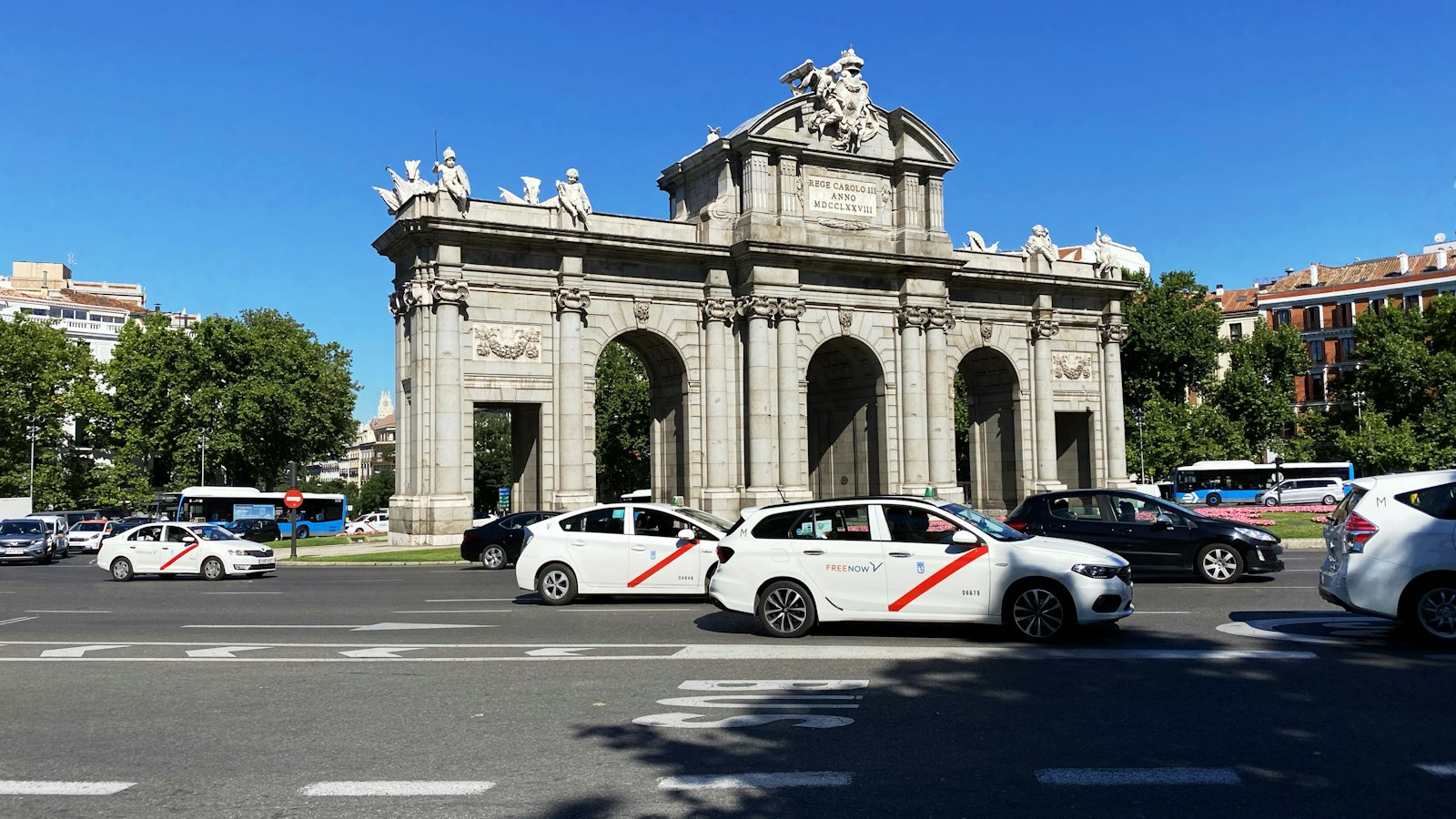
In short: a taxi licence in Madrid runs between €180,000 and €220,000 depending on the rest day and whether a car is included. But before the number, the important part: there is no official price. Licences are bought and sold between private parties, and almost every figure in circulation is an asking price in an advert, not a closed deal.
How much a taxi licence costs in Spain
These are the benchmarks the market is working with in October 2026. Read them as ranges, not as price lists:
| Licence | Price |
|---|---|
| Madrid, most deals (no car) | €180,000-210,000 |
| Madrid, rest day Thursday or Friday | over €200,000 |
| Madrid, car included | up to €220,000 |
| Barcelona (AMB) | €145,000-185,000 |
| Valencia | €150,000-175,000 |
| New licence from the council | €200-500 (no quota) |
The Madrid figures were published by OKDIARIO on 21 October 2026, describing an all-time high: most deals close between €180,000 and €210,000 without a vehicle. Adverts on Wallapop ask for the same: between €180,000 and €210,000 for the licence alone. In Barcelona adverts range from €165,000 to €185,000, with metropolitan licences from around €145,000, and in Valencia they sit between €150,000 and €175,000.
Why there is no official price
This is the part worth understanding before you look at a single advert. A taxi licence is not sold by the city council at a set price. The council decides how many there are and authorises changes of holder; the price is agreed between seller and buyer.
That has three practical consequences:
- There is no public register of closing prices. Nobody publishes what each licence actually sold for.
- What you see on the portals are asking prices. What is asked and what is paid are not the same, and the gap is set by negotiation.
- Many figures come from someone who wants to sell you something. A good share of the price guides that come up on Google belong to lenders and brokers who earn if the deal closes. Don't dismiss them, but know what you are reading.
The fee for a new licence is public, and it shows the distortion: it would be around €200-500. The catch is that there is no quota. That door has been shut for years, and that is why the only real route costs four hundred times more.
The rest day moves the price more than anything else
If you take one fact from this article, make it this one. Each licence carries a compulsory rest schedule, and not all rest days are worth the same.
Licences resting on Monday, Tuesday or Wednesday are the cheapest and sit at the bottom of the range. Those resting on Thursday or Friday, which therefore allow working the whole weekend, go above €190,000 and often above €200,000. It is the same administrative right, with the same car in the same city, costing tens of thousands of euros more.
It makes sense: the weekend is when takings peak. But do the maths before paying the difference, because those extra thousands have to come from somewhere, and that somewhere is your shifts. If you do not know what an hour on a Saturday night actually leaves you compared with one on a Tuesday morning, you are paying a premium blind.
What you pay on top of the licence
The price of the licence is not the cost of the deal. You also have to add:
- Transfer tax (ITP). Each region sets the rate, so do not trust a generic percentage you read somewhere: confirm it for yours before signing.
- The fee for authorising the transfer. In the Barcelona metropolitan area, for instance, the AMB requires prior authorisation and payment of a fee, and while it is being processed the licence is encumbered and cannot be operated. The amount is in its fiscal ordinance.
- Gestoría and notary: around €500-2,500, depending on how complex the contract is and whether financing is involved.
- The vehicle, if it is not included, plus insurance, adaptation and the taximeter.
And one procedural detail that catches many people out: the buyer must have no final penalties outstanding, and must be up to date with the tax office and Social Security.
The licence as an investment: the small print
This is where almost everything you will read turns optimistic, so here is the nuance.
The sales argument is solid on paper: the licence can be inherited, sold and in some places rented, the quota is frozen and the value goes up. The historical data backs it. OKDIARIO cites the CNMC, Spain's competition authority, which recorded a 503% rise on the secondhand market between 1987 and 2016. Plenty of people in the trade treat it, literally, as their pension plan.
But that value does not rest on the car or on demand: it rests on an administrative decision, the decision not to issue new licences. And an administrative decision can be revisited. Right now there are three open fronts worth looking at before signing a fifteen-year loan:
- The judicial route. The Supreme Court set aside the 1 VTC per 30 taxis limit in the Canary Islands because it was not shown to be necessary and proportionate. The reasoning does not stay in the Canaries.
- The competition already on the street. The VTC fleet grows while the taxi fleet shrinks: there is one VTC for every 1.6 taxis in Madrid.
- What is coming. Waymo's robotaxis, already testing in Madrid, will need transport authorisations to charge in 2027. Where those authorisations come from is, precisely, the question that affects what your licence is worth.
None of this means the licence is about to collapse. It means it is not a risk-free asset, and anyone selling it to you as one is skipping part of the story.
How much you need to take to pay it off
Let's do the simplest possible sum. A licence of €180,000 financed over 15 years is €12,000 a year, that is €1,000 a month in principal alone, with no interest, no insurance and no car.
Those €1,000 are one more fixed monthly cost, just like fuel or your self-employed contributions. And that is the point: the useful question is not “how much does the licence cost?” but “how much does each hour have to leave me so it pays for itself and I still take a wage?”. No advert answers that second question. Your own numbers do.
How Taxio handles this
Taxio does not buy or sell licences, and it will not tell you whether the price you are quoted is fair. What it does is give you the figure that decides it: you record every ride with its platform's commission and every expense, and the app tells you your real average of euros per hour and your net instead of your gross.
With that you can do what almost nobody does before signing: compare what a weekend really leaves you against a weekday, and see whether the expensive licence pays for itself or you are the one paying for it.
Frequently asked questions about the price of a taxi licence
How much does a taxi licence cost in Spain?
There is no official price, because licences are bought and sold between private parties. In Madrid, in October 2026, most deals close between €180,000 and €210,000 without a car, and those that allow weekend work go above €200,000. With a car included they can reach €220,000.
Can you apply to the city council for a new taxi licence?
In practice, no. The official fee for a new licence would be around €200-500, but the quota is frozen in the big cities, so the only real route is buying a licence from an existing holder on the secondhand market.
Why do some taxi licences cost more than others?
Because of the rest day. Each licence carries a compulsory rest schedule, and those resting on Monday, Tuesday or Wednesday are worth far less than those resting on Thursday or Friday, which allow working the weekend, when takings are highest.
What else do you pay besides the price of the licence?
Transfer tax (ITP), whose rate each region sets; the municipal or metropolitan fee for authorising the transfer; a gestoría and notary, around €500-2,500; and the vehicle, if it is not included in the deal.
Is buying a taxi licence a good investment?
Its value rests on the number of licences staying frozen. That has worked for decades (Spain's competition authority, the CNMC, recorded a 503% rise on the secondhand market between 1987 and 2016), but it is an administrative decision, not a law of physics, and right now it is under judicial and technological pressure.
Keep reading
Spain's Supreme Court strikes down the 1 VTC per 30 taxis cap
DGT changes from 1 October: what affects taxi drivers
Catalonia's taxi law: 600 fewer VTC licences and Brussels' warning
All articles
- How many taxi licences are there in Spain? 59,475 in 2026
- Waymo robotaxis in Madrid: testing now, passengers in 2027
- Verifactu and the taxi trade: who is actually required to comply, and from when
- One in three taxi licences in Salamanca is now held by a foreign professional
- Mandatory seatbelts for taxi drivers from October 1: the exemption that disappears
- 'Dominguito': the 1988 Mercedes still driving as a taxi in Gran Canaria after 7 million kilometres
- The Seville taxi driver who returned a bag with over €4,000 to a tourist couple
- Barcelona's 1943 electric taxi that swapped batteries in minutes — no charging wait at all
- Uber, Free Now, Cabify and Bolt commissions for taxi drivers in Spain (2026)
- Gross vs. net: what you really earn behind the wheel
- Deductible taxi expenses in Spain: the 16 worth tracking
- Your average euros per hour: the number that puts your shift in order